
The Malet Arms
By Terry Grace
Some friends and I recently attended a history talk in the Newton Tony village hall. Before the talk, we had a very good meal in the Malet Arms, which has just been taken over by new management. Whilst there, I was reflecting on how much the fare being offered had changed since I had known it.
In the early 1970s, when at Christmas time, a group of us from Porton Down would journey out at lunch time, to local pubs for the odd celebratory imbibement, one of the pubs of choice was the Malet Arms. Now, I should say that the attraction of this pub was not its décor or its ambience, of which it had neither, but the beer, which at that time was still of the traditional variety and was infinitely superior to the to the sea of tasteless, gaseous offerings from the giant conglomerates such as Watney’s Red Barrel, Whitbread Tankard and a host other brands.
I still have an indelible image of our first trip there. On entering the completely empty pub and approaching the bar, a massive Alsatian dog rose from the other side and plonked its front paws on the bar and assessed our reason for being there, in a menacing manner. Eventually, an elderly lady appeared, with a cigarette hanging from her mouth. Our 4 pints were ordered and I have a memory of said lady disappearing for some time to the back of the pub and coming back with our beers and spilling much of it, rather in the manner of the July Waters soup waitress sketch. If there was any food available, it would have been at best a pickled egg in a bag of crisps.
But anyway, the beer was good and we probably had another or so, but to describe this pub at that time as a “spit and sawdust” type of pub would be somewhat exaggerating, as there was no sawdust!
How things change, with a friendly welcome, good food and a range of good beers and wines, the pub must surely now be a great asset to the village and long may it remain, but what of its history?
There has been a house on the site where the Malet Arms now stands for 350 years or more and many of its early structures are extant. The date when this house became a pub is not known, but it eventually became the Three Horse Shoes. There was also another pub in the village known as The Malet’s Arms. This was in the Beechfield area of the village on the south side and back from the road, accessed, as far as I can make out, by the driveway between what is now Nos 21 and 23. Note that in both the 1879 OS map and early articles in the Salisbury Journal, the name is The Malet’s Arms.
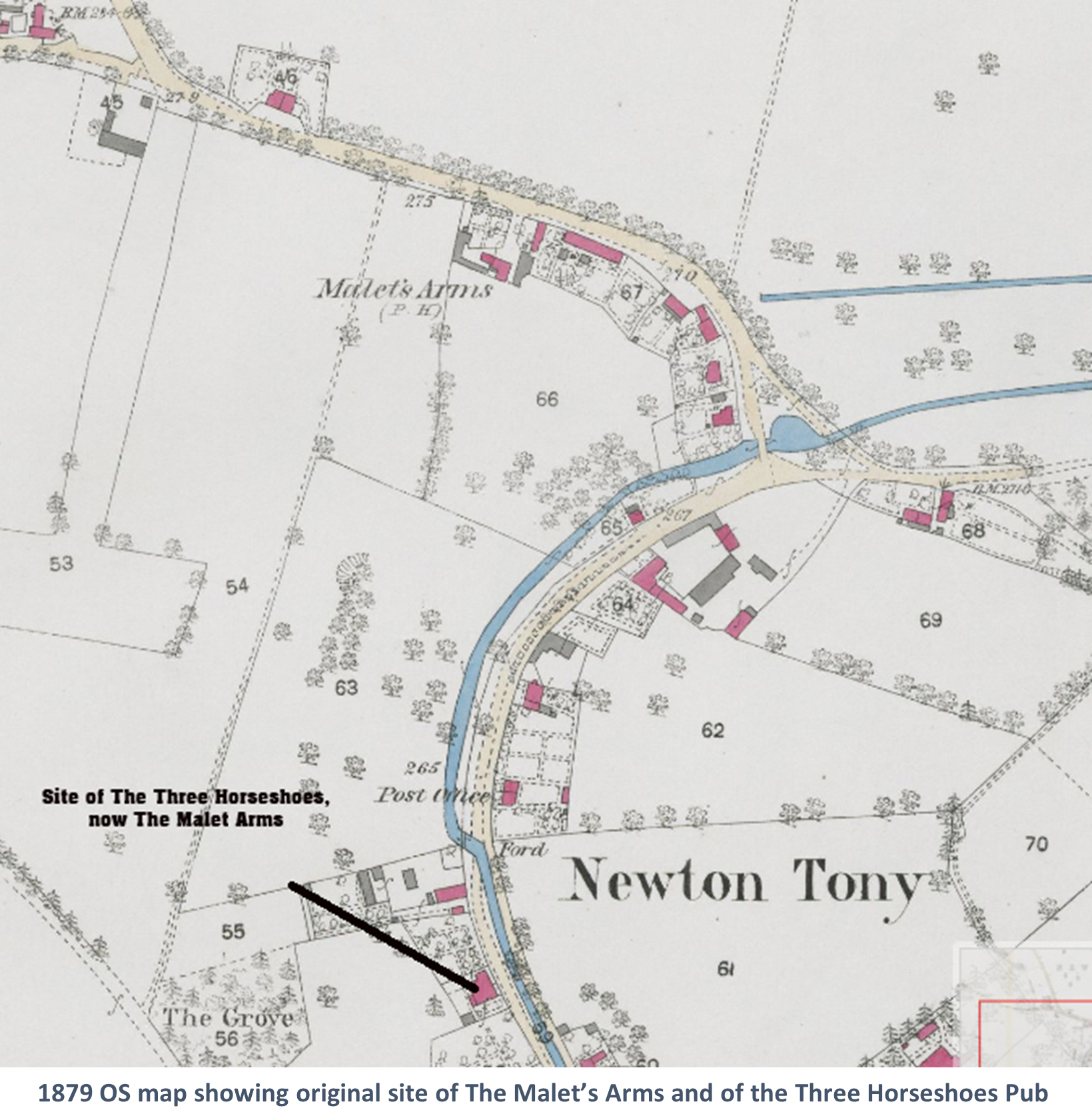
It is interesting that on the above map, the Three Horseshoes is not identified. This is probably because it was a beer house, which did not sell spirits. This was a category which existed from 1830 to 1961, which meant it was not listed as an Inn with full licensing on the map.
The first reference to The Malet’s Arms in the newspapers is in January 1843, when we hear of a pigeon shooting competition at ‘Newtontoney’ for a fat pig. In 1846, there is a report of a cricket match between ‘Newtontoney’ and Winterslow. ‘The party afterwards partook of a good dinner at the Malet’s Arms.’ After this time, the inn is referred to as the Malet Arms and there are reports of timber sales, raffling for a gun in 1863, the death of landlord Mr G. Rose in 1870 and the sale by his widow of all the household effects in 1871. In 1872, Mr Holloway appears to be the landlord and a Harvest Thanksgiving tea was held at his coach house, but in 1874, the licence of the Malet Arms was transferred from Mr Holloway to Mr Brown. In 1880, the Inn was to be let with immediate possession from Mr Gifkins on the premises. Confusingly, in 1882, in a court case in Salisbury, we hear of a Mr Holloway, retailer of beer at Newton Toney, deposed.
In 1887, Mr J.J. Elton of The Malet Arms was in the bankruptcy court and in 1892, the licence of the Malet Arms was transferred temporarily from Mr A. Moore to Mr J Diment.
As has been suggested above, there was also another drinking establishment in the village at that time known as the Three Horseshoes, but this name does not appear in the newspapers until 1895 when we learn that George Olden of Newton Toney is to be granted a full licence and that the name of his house to be changed from the Three Horseshoes to the Malet Arms. Mr Olden told the licensing authorities that up to that time there had been two public houses in Newton Toney, one being the Malet Arms, which was a fully licenced and the beer house occupied by himself. By arrangement with Henry Malet, who owned both houses, the fully licenced house was to be closed and he was asking that the full licence should be transferred to the beer house. The following picture shows the Malet Arms in 1904. George Olden had died in 1899 and when this picture was taken, his widow, Martha, was the licencee.

Now, although until this transfer there had been no mention of the Three Horse shoes in the local papers, there are snippets about the beer house. In 1880, Mr R. Z. Cook was applying for renewal of a licence for a beer house in Newton Toney. He had apparently been twice convicted for offences that year and was asked to provide character references.
So, as far as we know, there were two pubs in Newton Toney, reduced to one in 1895, but in The Newton Toney Millennium Book, there is mention of a possible third establishment called the Swan Inn and there is an extract from the sales catalogue for the 1802 sale of the Wilbury Estate, which mentions this and a man named William Postan. I have tried to solve this puzzle with little success, save for a fleeting reference to the possibility of there being a Swan Inn at East Cholderton where the garage now stands. I take this to be Park House? Now, Park House Inn was a 17th-century coaching inn; could it be that before 1802 it was known as the Swan? We don’t know.
William Postan was perhaps an auctioneer and so may have been involved
In 1897, the former Malet Arms was to be let with 87 acres of arable land.
In 1924, the Malet Arms was leased to Strong and Co for 21 years at £50 per annum.
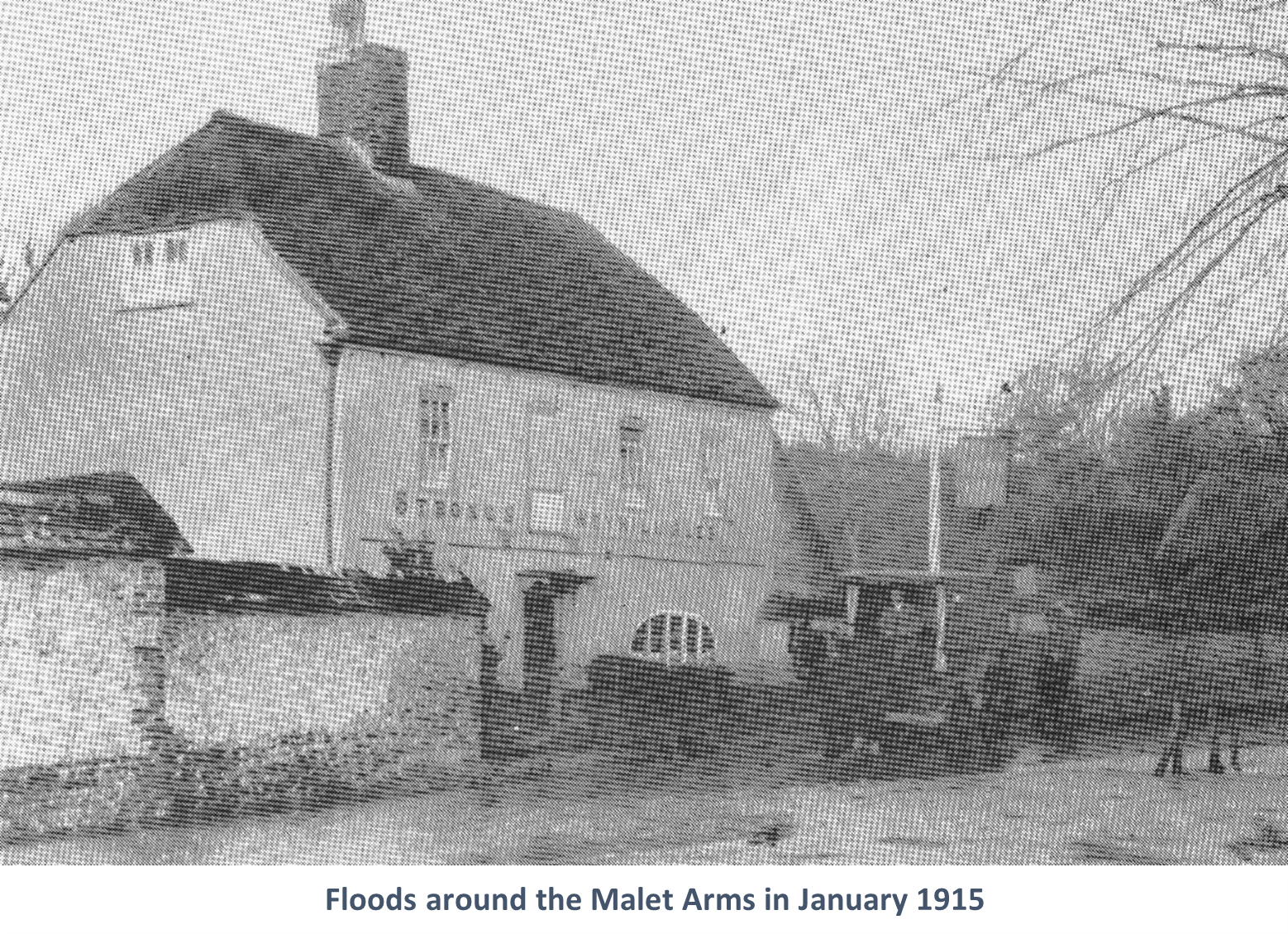
The Malet Arms sits on the river Bourne and the scene is often one of bucolic excellence; however, there are times when this stream, which at our time of visiting in early October 2025, was completely dry, becomes a raging torrent and the pub, like many of the local houses, have been flooded. The year of 1915 was particularly wet and many villages through the valley and across Salisbury Plain were affected. The following picture shows the Malet Arms in such a situation in that year.
Fire too almost caused a disaster in February 1939, when smoke was seen issuing from one of the rooms. We are told by the Salisbury Times that’ the siren was sounded at Amesbury at 1030 and the brigade under first officer Mathews was on its way in three minutes. The distance of six miles was covered in 12 minutes in spite of fog patches. On arrival, it was found that a beam in the chimney was alight, but it was soon quenched by chemical extinguishers.
The pub takes its name from the Malet family of Wilbury Estate. The Malet name is Norman in origin and comes from the given name Malle, which is from the Old English and is the diminutive of Mary, or from the given name Malo. The name arrived in England with the Norman Conquest and is first noted in Suffolk. All families of this name can trace their ancestry to William Lord Mallet de Granville, who was one of the Barons accompanying William the Conqueror.
In terms of heraldry, The Coat of Arms, which these days is displayed on the pub sign, consists of three ecallops on an azure background. The scallops represent pilgrimage.
Bibliography and resources
Anon.; Newton Tony: A Wiltshire Village at the Millenium (Platinum Printing) 2000
Daniels, P; Around Amesbury in Old Photographs (Alan Sutton) 1990
Kidd. A, Down Your Way: Vol. 1 (Bath Press) 1988
Various online resources including British Newspaper Archives.